Wednesday, April 15, 2020

Section of DOSH enforcement division up for privatisation (Borneo Post, 11/1/2020)

Section of DOSH enforcement division up for privatisation

Kulasegaran (seated centre), flanked by Dr Ting (second right) and Nor Halim, joins DOSH Miri staff in a photo-call.

MIRI: A certain section of the Department of Safety and Health (DOSH) Sarawak’s enforcement division would be privatised to counter the problem of insufficient manpower.

In stating this, Human Resources Minister M Kulasegaran observes that the enforcement section only has 111 technical officers, which is insufficient to ensure smooth running of the department.

“The enforcement section has shortage of enforcement officers. DOSH Sarawak had applied for 50 new officers, but the government, since several years ago, had not allowed (for) additional staffing.

“We have looked at other efforts, and have proposed for a certain section of the enforcement (division) to be taken over by the private sector. This will enable the department to relieve its enforcement officers, so that they can concentrate on some other areas,” he told reporters after attending a briefing at DOSH Miri office yesterday, where Pujut assemblyman Dr Ting Tiong Choon and DOSH Sarawak director Dr Nor Halim Hasan were also present.

Kulasegaran said the plan to privatise a section of DOSH was not something new; rather, this had started in 1998. However, the proposal had yet to take effect, he said.

“Last year when I visited Singapore, I saw that their privatised enforcement section had saved a lot of government’s money and time. The enforcement operation was also (running) much better, where complaints and corruption or allegation of this nature, had been very much reduced.

“So I’m proposing that we accelerate the proposal for privatisation. This will also allow, maybe 50 per cent of the enforcement staff to go and do other works – so they will have enough manpower to conduct investigations, audits and other things,” said the minister.

Kulasegaran disclosed that one of the most worrying things was the number of backlog of inspections throughout the country. In 2018, about 30 per cent of inspections could not be done due to insufficient manpower.

“But the situation is better in Sarawak, with only about 10 per cent of backlog. I must thank DOSH Sarawak director and his team for doing a good job,” he said, adding that the target should be to have zero backlog and zero occupational accidents.

Meanwhile, Kulasegaran was happy to note the improvement and progress shown by DOSH Sarawak over the past year.

“Last year, only 32 fatalities recorded from workplace accidents, versus 47 in 2018. This is an improvement and the reason for this could be caused by increased inspections by the DOSH,” he said.

He added that last year, DOSH also recorded a total of 28 permanent disability cases, 414, non-permanent disability cases as well as 450 cases of occupational poisoning and diseases.

“I was given to understand that some were hearing loss, because the workers were not wearing hearing(-protection) gears,” he said.

DOSH Sarawak also recorded about RM2 million in revenue and RM928,500 derived from compounds and prosecution cases last year – in comparison, DOSH revenue for the whole country was RM35 million.

That same year, a total of 1,744 punitive actions were taken against companies in Sarawak.

Touching on the incident of collapsed girder beams during the construction works on a bridge at the Pujut Link component of the Pan Borneo Highway development here last month, Kulasegaran said the department was still waiting for the forensic report to be completed.

“DOSH is conducting a forensic study about the matter. It’s being done now, but not yet completed. For the interim, we allow them to remove the debris.

“So we are now waiting for two things – the forensic study report as well as plans from the contractor involved about the incident and what has been done,” he added. - Borneo Post, 11/1/2020

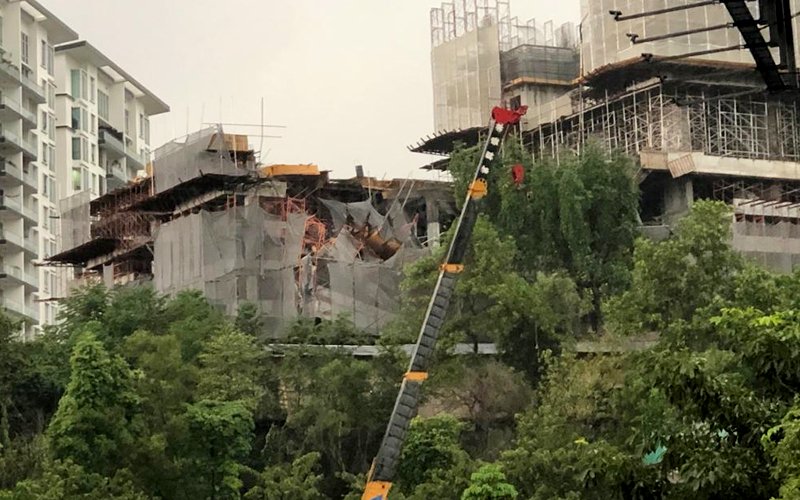
Taman Desa condo collapse - 4 trapped (EdgeMarkets 14/2/2020)

Taman Desa condo collapse: DOSH officers dispatched to investigate incident

-A +A
KUALA LUMPUR (Feb 14): The Ministry of Human Resources said a team of investigation officers from the Department of Occupational Safety and Health Kuala Lumpur and Putrajaya has been dispatched to check the collapse of a condominium structure in Taman Desa this afternoon.

The team has been sent there to identify the cause of the accident that took place at the residential area located along Jalan Klang Lama here, and to determine whether there have been any breaches under the Occupational Safety and Health Act 1994 and the Factories and Machinery Act 1967.

“As at 7pm, the investigation officers are still waiting for permission from the Fire and Rescue Department to enter the accident site, before proceeding with the investigation,” the Ministry said in a statement this evening.

The Ministry, however, did not state if there had been any injuries or fatalities from the incident.

Earlier, Bernama reported that four people were trapped when part of the structure of the condominium, which is still under construction, collapsed at around 3pm. At the time, it said one had been rescued and had been sent to hospital.

It also quoted a spokesman from the Kuala Lumpur Fire and Rescue Department as confirming the incident. - Edge Markets, 14/2/2020

Perak company fined RM35,000 for negligence in contractor's death(NST, 1/8/2019)

Perak company fined RM35,000 for negligence in contractor's death

IPOH: A company was fined RM35,000 by the Sessions Court here today for negligence which resulted in the death of its contractor while fixing the company’s roof five months ago.

Lysaght Galvanized Steel Bhd which represented by its director and chief executive officer, Chua Tia Bon pleaded guilty when the charge was read to him before Judge Norashima Khalid.

According to the charge sheet, the 69-year-old man was accused of failing to ensure the safety, health and welfare of his employee while on duty.

Chua was also accused of failing to conduct safety workplace system in term of checking, fixing and changing the roof works which resulted in the death of its 55-year-old contractor Cheong Kim Loong.

Chua allegedly committed the offence at the company in Tasek Industrial Area here on April 22.

He was charged under Section 17(1) of the Occupational Safety and Health Act 1994, punishable under Section 19 of the same act.

The offence carries a maximum fine of RM50,000 and jail term of up to two years.

Lysaght Galvanized Steel Bhd which represented by its director and chief executive officer, Chua Tia Bon pleaded guilty when the charge was read to him before Judge Norashima Khalid. - NSTP/EMAIL
Deputy Public Prosecutor Fazira Azita Abdul Rashid represented DOSH, while the accused was not represented.

Earlier, the accused during mitigation said he was upset over the incident and has since improved the company’s safety system.

Chua said it was the first recorded case at the company and it has been following safety measures which set by the Department of Occupational Safety and Health (DOSH) following the incident, while pleading for a lower penalty.

However, Fazira Azira requested the court to impose a just punishment against the company as it had been operating for more than 40 years and that the incident should serve as a lesson.- NST, 1/8/2019

Company fined RM20k for not complying with DOSH prohibition notices - 2 offences(NST,Nov,2019)

Company fined RM20k for not complying with DOSH prohibition notices

A construction company was fined RM20,000 for failing to comply with two notices of prohibition issued by the Perak Department of Occupational Safety and Health (DOSH). -NSTP/File pic
IPOH: A contractor company, Loyal Engineering Sdn Bhd, was fined RM20,000 by the Sessions Court here today for failing to comply with two notices of prohibition issued by the Perak Department of Occupational Safety and Health (DOSH).

Its managing director Datuk Ong Kian Min pleaded guilty when the charges were read to him before judge Norashima Khalid.

According to the first charge, the company was accused of failing to comply with notice of prohibition issued on July 16 to immediately discontinue unsafe working activities that are using scaffolding.

For the second charge, the company was accused of failing to comply with notice of prohibition issued on the same date, to immediately discontinue unsafe working for the installation of falsework, formwork and rebar as no provision of personal protective equipment such as safety harness to employees which may cause fall injury.

Both offences were committed at the regional sewage treatment plant and sewer pipe network site project in Papan here on July 24 at about 1pm.

The charges are framed under Section 49(1) of the Occupational Safety and Health Act 1994 and Section 49(2) of the same act, which carries a fine of up to RM50,000 or imprisonment of up to two years or both, upon conviction.

DOSH prosecuting officer Ir Amirul Adli Hashim earlier requested for the maximum punishment under the law.

Ong, who was not represented by counsel, sought a light penalty as it was the company’s first offence since it was established in 1995 and promised not to make the same mistake again. - NST, 28/11/2019

DOSH must take rap for worksite deaths and injuries(FMT)

DOSH must take rap for worksite deaths and injuries

facebook sharing button
twitter sharing button
whatsapp sharing button
sharethis sharing button
The Consumers’ Association of Penang (CAP) is shocked by the Department of Occupational Safety and Health’s (DOSH) disclosure that 711 workers were killed on the job in 2017, with 183 of the fatalities occurring at construction sites.

In the latest worksite incident, an Indonesian couple was killed and three others were injured when a multi-storey car park under construction at the Gombak LRT station at Taman Melati collapsed on May 23.

This is an indication of the pathetic state of enforcement by DOSH and raises the question of whether the department is relevant any longer.


A number of construction projects are going on in the country and are a major contributor to the economy, yet the safety of the workers – mainly the manual workers – is not given the importance it deserves. It is as if their lives are cheap.

CAP has carried out surveys at construction sites and found that ,many workers do not wear safety apparel such as helmets, harnesses or fall protection equipment (when working above 2m), jackets, protective gloves and hearing plugs.

Who should be blamed for this non-compliance of safety requirements at the worksite: the employees, the employer or the enforcement body?

DOSH appears to believe that putting up “Safety First” notices at worksites absolves it and the developers from liability for accidents resulting in injuries and death.

The Occupational and Safety Act makes employers responsible for making worksites safe and it makes DOSH responsible for enforcing the Act. The death of 711 workers in 2017 is shocking and disgraceful to say the least. It means that those in the construction industry do not respect the law because they do not fear the law, and that is because of non-professional enforcement of the law.

DOSH says that projects costing over RM20 million are “self-regulated”. This means the project developers are required to hire their own safety experts on their sites and DOSH does not inspect these sites. It only inspects worksites of projects costing less than RM20 million.
DOSH is wrong to think that “self-regulated” projects do not need to be audited by it. Is safety beingcompromised as it might cost more to put in all the safety measures required under the law than to pay compensation for the life and limb of manual workers? Why does DOSH think that there is no need to check on the safety consultants’ work at these big projects? 
 
In two major landslide cases in Tanjung Bungah and Bukit Kukus, Penang, DOSH highlighted that the contractors did not comply with safety standards as required by the law and that negligence subsequently killed more than 20 workers in both cases.

Taking action only after major accidents have happened and people have been killed is not a consolation to the families of the victims. The recalcitrant consultants should be deregistered to send a strong message that any incompetency and negligence will not be tolerated.

DOSH’s claim that it practises professionalism in carrying out its duties appears hollow. It states that it carries out surprise checks at worksites and at the same time laments that its officers cannot be at the worksites all the time. This speaks volumes of its “professionalism”. If it is professional, it should put enough fear into the building construction industry such that no one would dare breach any safety regulation. Until and unless DOSH starts enforcing the law strictly, it cannot claim to be exercising professionalism in its regulatory work.

Recommendations for worksite safety

CAP recommends the following for improvement of worksite safety:
  1. For each worksite, there must be one dedicated consultant who is in overall charge of safety. This person is responsible for the prevention of accidents on the site.
  2. DOSH must carry out spot checks at all worksites, including the so-called “self-regulated” ones.
  3. DOSH should impose the maximum penalty for the first offence to drive home the point that workers’ safety is a serious matter.
  4. Section XI of the Occupational Safety and Health Act gives wide powers of investigation and action against those who breach the law. The law needs to be enforced strictly. It does not give discretionary powers to let anyone off lightly.
  5. Current penalties of a RM50,000 fine and imprisonment of not more than two years are grossly inadequate and not deterrent at all. Light penalties only encourage the breach of laws as it is cheaper to do so than to comply. The penalty should be raised to not less than 10% of the project cost or not less than two years’ imprisonment, or the irresponsible employer should be penalised under the Penal Code for manslaughter in the event of fatalities.
  6. DOSH must conduct a follow-up check at the worksite after the contractor or developer is issued with a stop-work order. In the case of the landslide at Bukit Kukus, it was revealed that a stop-work order was issued but the developer did not comply with it. DOSH should examine any violation of the stop-work order and take immediate action against the developer.
  7. The guilty party should be charged in court and a suitable sentence meted out so as to set an example for the rest in the industry.
We urge DOSH to take a tough stand against errant contractors and developers. It has to take urgent measures to rectify this festering problem that affects those who help to build the nation.

Mohideen Abdul Kader is vice-president of the Consumers’ Association of Penang. - FMT, 24/5/2019

Thursday, April 9, 2020

Salary Deduction and Unpaid Leave Should not be Made an Option during Lockdown(LRRC)

Press Statement by Labour Law Reform Coalition on 8 April 2020 in Shah Alam
Salary Deduction and Unpaid Leave Should not be Made an Option during Lockdown
Labour Law Reform Coalition welcomes the announcement of the government on 6 April 2020 that an additional RM10 billion stimulus package would be allocated to support micro, small and medium enterprises, the total amount of wage subsidy has been substantially increased from RM5.9 billion to RM13.8 billion.
However, we have grave concern that the Prime Minister, during the announcement, said that the government encouraged “negotiations between employers and employees on their terms of employment, including an option for salary deductions and unpaid leave during the MCO.”
This statement will unwittingly open a floodgate for employers to exploit Malaysian workers by denying paid leave during the lockdown period. With tremendous financial support by the government at the expense of tax payers’ hard-earned money, it is unreasonable if companies cut workers’ wages or ask them to go for unpaid leave.
In addition, given the fact that only 4 per cent of private sector workers were unionized in the country, most of the workplaces do not have legally sanctioned bargaining units, that is, trade unions. Hence, the proposal is unpractical and ineffective as the precondition of collective bargaining does not exist. The announcement will be easily manipulated by employers to their advantage.
We urge the government to grab the opportunity to require companies to establish trade unions as a precondition of receiving government fund. This measure not only will realize collective bargaining in accordance to the financial situation of the company, but also encourage industrial harmony in the post-lockdown period which is full of uncertainty for businesses and working classes.
Nadesan Gopalkishnam & Irene Xavier
Co-Chairpersons
Labour Law Reform Coalition


Note : Labour Law Reform Coalition is endorsed by 58 Trade Unions from various sectors and worker organisations. The group started in June 2018 to initiate discussion on labour law reform bases on ILO’s decent work framework. The coalition had submitted proposals of reforming Employment Act 1955, Trade Union Act 1959 and Industrial Relations Act 1967 in January and May 2019 respectively.

Nadesan Gopalkishnam is the General Secretary of National Union of Transport, Equipment and Allied Industry Workers (NUTEAIW), he is the immediate past Secretary-General of Malaysian Trade Union Congress. Irene Xavier is a veteran social activist who founded Persatuan Sahabat Wanita Selangor, she has been fighting for the rights of women worker for decades.


Press Statement by Labour Law Reform Coalition on 18 March 2020 in Shah Alam

Groups call for comprehensive investigation into death of 5 workers killed in the Pengerang tragedy

The Labour Law Reform Coalition (LRRC), comprised of 58 trade unions, migrant worker groups and non-governmental organisations, calls for the Government to begin a comprehensive investigation into the tragedy at the Johor Bahru petroleum refining complex on 15/3/2020 that  left five workers dead and one seriously injured.
Investigations must be conducted by, amongst others, the police, the Fire Department, the Department of Occupational Safety and Health (DOSH) and all relevant agencies.
The explosion occurred at Pengerang Refining and Petrochemical (PRefChem)’s Hydro Diesel Treater Unit at the Pengerang Integrated Complex on Sunday night. 42 Fire and Rescue personnel and nine vehicles battled the blaze for a full twelve hours, and operations have been suspended to enable investigations by the Department of Occupational Safety and Health.
PRefChem is a strategic alliance of two of the world’s largest national oil companies — Petroliam Nasional Bhd (Petronas), the national oil company of Malaysia, and Saudi Aramco, the national oil company of Saudi Arabia.
It was disappointing when the Johor Police Chief, Datuk Ayob Khan Mydin Pitchay, was reported saying that the police will only investigate if there was sabotage, betrayal or terrorist involvement. [“Polis hanya akan membuat siasatan jika ada unsur sabotaj, khianat mahu pun serangan pengganas dikesan pada fasiliti berkenaan.’- Berita Harian, 17/3/2020]
This is unacceptable, as the police must investigate comprehensively to determine whether there was any crime, including murder or manslaughter, and determine whether there is anyone criminally liable for the deaths and injury caused.
There must be an inquest conducted for all these deaths.
There must be no special treatment accorded simply because Petronas is involved.
“We extend our deep sympathies to their families and workmates of Fadhi Akmal Fadzil, Azarul Ashraf Nor Akmal, Norfazly Md Nor, Che Huzaidy Che Harun and Hadi Syafiq Jamil who died in this tragic and possibly avoidable accident”, said LLRC co-chair Irene Xavier.
“Occupational safety and health is the responsibility of employers, however the increasing regularity of instances like these clearly demonstrate that workers cannot trust them to execute this responsibility, particularly in high risk sectors like petrochemical and construction”, she continued.
“This is not a problem that popped up yesterday and won’t be solved without a meaningful change in employers’ behaviour to ensure workers’ safety is truly valued. Unless there is a serious threat of prison time for bosses’ whose negligence or laxity results in workers’ deaths, workers will keep dying.”
The LLRC also calls on the government to begin drafting more deterrent laws, including also industrial manslaughter legislation, that provides for mandatory prison sentences for employers or company directors who by their actions and/or omissions result in workers death at the workplace.
Irene Xavier (+60) 11 1539 9960
Labour Law Reform Coalition (LRRC)

*The Labour Law Reform Coalition is a group of 58 trade unions, migrant worker organisations and non-govermental organisations lobbying for reforms to Malaysia’s labour law to create decent work.
Media References:-


Saturday, April 4, 2020

Can COVID-19 be considered an occupational disease?(ISSA) - YES, it can.

Responses to the COVID-19 crisis

Can COVID-19 be considered an occupational disease?

Worldwide almost 2.4 million people die due to an occupational disease, compared to 0.38 million that die because of a work accident. Insurance covering occupational diseases is an important pillar of social security and a safety net to all workers who may be exposed to chemical, physical or biological agents arising from work activities, or may suffer from respiratory and skin diseases, musculoskeletal disorders, post-traumatic stress disorders or occupational cancer.

In view of the rapid spread of the Coronavirus, countries are now facing the urgent question of assessing COVID-19 as an occupational disease. In order to ensure insurance coverage, in particular for workers in the most exposed sectors, rapid measures to facilitate the recognition of COVID-19 have been implemented in a number of countries.

Recognition Process for an Occupational Disease

In order to assess whether or not COVID-19 is an occupational disease, it is essential to have distinct and transparent criteria for the definition of occupational diseases, which will help to distinguish these from diseases of different origins. Around the world, various recognition procedures exist that would determine the occupational nature of the disease. This procedure can be based on individual (medical and technical) assessments. Data relating to exposures in the workplace, as well as scientific surveys on occupational risks, are also useful tools to be used in the recognition procedure, which can be organized in different ways, namely:  
  • A national list of occupational diseases containing the precise recognition criteria, supplemented by a complementary system of recognition for diseases which are not on the list, is in most cases an efficient way to have clear and validated recognition criteria.
  • The recognition procedure can also be based on the individual assessment of cases by experts.
  • A combination of these two systems is possible. This would mean that (a) a national indicative list or the list of occupational diseases published by the International Labour Organization (ILO) or the European Commission is used as a reference and (b) investigations on a case-by-case basis are conducted to further determine the causal link between work and the disease.

Systematic Approach to Occupational Diseases for Social Security

A systematic approach to occupational diseases, starts from individual suspicion of an occupational disease and ends with the final decision on whether or not the disease will be recognized by the social security institution. The decision on such recognition depends on the causality between the disease and the workplace.
System of identification and recognition of occupational diseases
Source: ISSA Guidelines: Prevention of Occupational Risks (2019)

The ILO List of Occupational Diseases

COVID-19 is of course not explicitly mentioned in the ILO list of occupational diseases (2010). It only lists HIV, Hepatitis B and Hepatitis C as virus infections, which are recognized as occupational diseases. However, COVID-19 falls under Article 1.3.9. :

“1.3.9. Diseases caused by other biological agents at work not mentioned in the preceding items where a direct link is established scientifically, or determined by methods appropriate to national conditions and practice, between the exposure to these biological agents arising from work activities and the disease(s) contracted by the worker.“

Practically speaking, there needs to be a direct link between the exposure to the coronavirus itself (SARS-CoV-2) at work and the disease (COVID-19) to be able to classify it as an occupational one. 

The first condition – the scientific evidence that SARS-CoV-2 causes COVID-19 - is a proven scientific fact, but in many cases, it will be difficult to create the causal link; to prove that the disease was contracted at work. If proved that the virus was contracted through occupational exposure, any worker is covered under the ILO list.

However, not all countries follow the ILO list and many have their own national lists or assessment criteria to determine the occupational nature of a disease.

National examples of COVID-19 recognition

  • The National Employment Accident Insurance Institute of Italy (Istituto Nazionale per l'Assicurazione contro gli Infortuni sul Lavoro - INAIL) confirmed that coronavirus infections of doctors, nurses and other employees of the National Health Service (Servizio Sanitario Nazionale – SSN) as well as of any other public or private health facility are considered occupational diseases. The causal link between the work and the infection will be automatically assumed for this group of employees in order to also provide coverage to cases in which the identification of the specific causes and working methods of the infection is problematic. Furthermore, COVID-19 cases where SARS-CoV-2 was contracted while commuting to work or back home are also covered by INAIL.
  • The German list of occupational diseases  mentions virus infections (No 3101), which considers viruses as an occupational disease if the employee works in the healthcare sector. But it does not consider a virus an occupational disease for any other economic sector (like public transport, supermarkets, construction, office workers, etc.)  
  • In South Africa, COVID-19 is recognized as an occupationally acquired virus disease if it is the result of occupational exposure, which happens in a presumed high-risk work environment or during an approved official work assignment to high risk areas or countries. Furthermore, a chronological sequence must exist between the work exposure and the development of COVID -19 symptoms.
  • Canadian Workers’ Compensation boards compensate their workers for COVID-19 if there is medical proof that the worker has been diagnosed with COVID-19 has been exposed to SARS-CoV-2 at work and if the exposure is confirmed to be work-related.

Social Security Prevention Responses to COVID-19

The sooner an occupational disease can be detected and addressed, the higher the chance of a cure and reintegration into work. Hence, the timely diagnosis of relevant symptoms allows not only for effective medical treatment but also for workplace interventions such as changes to work processes (like teleworking), improved hygiene measures and the use of protective devices. The ISSA’s Special Commission on Prevention has published a list of measures that can be shared by occupational accident insurances to ensure that the COVID-19 will not spread at the workplace. - The International Social Security Association (ISSA)

Wednesday, April 1, 2020

47 Groups - Make COVID-19 an Occupational Disease under Law to ensure social protection for all workers and their families

Media Statement – 2/4/2020

Make COVID-19 an Occupational Disease under Law to ensure social protection for all workers and their families

We, the 47 undersigned groups, organizations and trade unions, in response to the advent of Covid-19, an infectious disease that can easily be transmitted to other human persons, including workers, urge that the Malaysian government immediately recognize and make Covid-19 an occupational disease. 

By so doing, workers who are infected by Covid-19 at their workplace, even during this period, will become entitled to social protection accorded by social security schemes and laws.

For those who die, by reason of getting infected by Covid-19 at the workplace, will also be easily entitled to compensations, and their spouses/children/elderly parents will also become entitled to survivor benefits including pensions.

Employers have a duty in law to ensure a safe working environment, and will also now be required to ensure that the workplace is safe from Covid-19 and/or any other dangerous communicable diseases, especially those can result in death or other permanent disabilities.

With the movement control order in place, which still requires workplaces that provide for essential services to operate, workers traveling to and from work, and at these workplace are everyday at risk of being infected by the Covid-19 virus, which to date has also resulted in many deaths worldwide, and as such workers need protection, and this can be done by specifically classifying Covid-19 as an occupational disease.

Now, recently even workers in charge of Human Resources, are required to travel and return to their workplaces for the purposes of arranging the monthly payment of salaries to workers.

Workers who are also needed (or forced) to stay in particular accommodation by employers, should also be covered. This also ought to be considered an ‘occupational disease’, and be accorded all the needed social protection.

While the Covid-19 pandemic highlights the inadequacies in occupational safety and health laws, and also social security laws for workers, it is time to remedy these failings.

One must note, that in the past, there has also been allegations of some workers forced to house together or work together has ended up contracting life threatening ailments like tuberculosis from other workers they are made to stay and/or work with.

All such ailments, not just Covid-19, which can cause death or other disabilities that may impact these workers future employment and income, ought to be specifically classified as occupational diseases, and workers should be accorded all benefits under social protection laws.

These laws should apply to all workers, including migrant workers and domestic workers.

In Malaysia, local workers are generally covered by the Employees' Social Security Act 1969, which provides better protection to workers and/or their families compared to the Workmen’s Compensation Act 1952 that generally covered migrant workers. There must be equal protection for all workers, even domestic workers.

For now, The Human Resource Minister, can use the powers conferred by subsection 32(2) of the Occupational Safety and Health Act 1994 [Act 514], and declares that Covid-19 be recognized as an occupational diseases. Other changes and/or amendments to law to ensure equal protection to all workers may require Parliament.

Therefore, we 

-          Call on Malaysia to  immediately make Covid-19 an occupational disease, especially if it is contracted at the workplace, on journey to and from work, and in worker accommodations provided by the employer;

-          Call on Malaysia to amend all relevant worker social security law, to ensure appropriate just remedy to workers, their families and/or dependents especially in the event of death, or disability impacting future capacity to work and/or earn an income;

-          Call on Malaysia to ensure that employers are legally bound to provide a safe working environment, including safety from infection from human to human contact at the workplace for diseases like Covid-19,

-          Call on Malaysia and all employers to ensure that occupational safety and health of all workers are always prioritized and protected.    

Charles Hector
Apolinar Tolentino 

For and on behalf of the following 47 groups

WH4C(Workers Hub For Change)
Malaysian Trade Union Congress (MTUC)
Clean Clothes Campaign Network (CCC)
Building and Wood Workers International (BWI) Asia Pacific Region
Labour Behind the Label, United Kingdom
Odhikar, Bangladesh
National Union of Transport Equipment & Allied Industries Workers (NUTEAW), Malaysia
Persatuan Kesedaran Komuniti Selangor (EMPOWER)
Timber Industry Employee Union Sarawak (TIEUS)
MADPET (Malaysians Against Death Penalty and Torture)
North South Initiative(NSI)
Kesatuan Sekerja Industri Elektronik Wilayah Selatan, Semenanjung Malaysia (KSIEWSSM)
Sarawak Banking Employees Union
MTUC Sarawak (Malaysian Trade Union Congress – Sarawak)
Malayan Technical Services Union           
Timber Employees Union of Peninsula Malaysia
Malay Forest Officers Union      
PKNS Union       
Sabah Timber Industry Employees Union
National Union of Flight Attendants Malaysia (NUFAM)
Legal Action for Women, United Kingdom
Global Womens Strike, United Kingdom
Malaysian Automotive Industry Workers Union Federation
Saya Anak Bangsa Malaysia (SABM)
National Union of Banking Employees(NUBE)
Persatuan Sahabat Wanita Selangor                       
Single Mothers’ Self-Defence, United Kingdom
Association of Human Rights and Defenders and Promoters- HRDP(Myanmar)
Banglar Manabadhikar Suraksha Mancha (MASUM), India
MARUAH, Singapore
IMA Research Foundation, Bangladesh
Legal Awareness Watch (LAW), Pakistan
Asociación de Trabajadoras del Hogar a Domicilio y de Maquila–Atrahdom, Guatemala
Programme Against Custodial Torture & Impunity (PACTI), India
Marvi Rural Development Organization (MRDO), Pakistan
Onward Consulting, Malaysia    
Women of Colour Global Women Strike, United Kingdom
Payday, United Kingdom
Women Against Rape (UK)
Bangladesh Group Netherlands
International  Black Women for Wages for Housework
International Jewish Anti-Zionist Network, UK
Asosasyon ng mga Makabayang Manggagawang Pilipino Overseas in Malaysia (AMMPO-SENTRO)
European Rohingya Council
WinVisible (women with visible & invisible disabilities)
Campaign Abiti Puliti (Italian CCC)
Collectif Etique sur l’etiquette, France

Wednesday, March 25, 2020

When DOSH fails in ensuring safe workplace - Employers can escape liability even in cases where death occurs?

When the Department of Safety and Health(DOSH) fails in its duties of ensuring OSH at the workplace, then employers may get off scot free even if a death of a worker happens.
DOSH is under a statutory duty to educate the employers and to ensure a safe workplace...Being a statutory body, DOSH has the statutory duty under s. 48 of OSHA to issue such notices if DOSH is of the opinion that the trailer is not safe to DOSH satisfaction. By not issuing such important notices, such inference can be gathered that the trailer is safe and does not risk the lives of the employees whilst using the trailer.
Could the family of the deceased worker then take an action against DOSH itself? Presumably YES...

DOSH really need to conduct a lot of visits and inspection of worksites, for their failure to identify RISKS and violations, and take necessary action to ensure a safe working environment - makes DOSH(the government) LIABLE for death and injury of workers caused in an unsafe working environment? 


JABATAN KESIHATAN DAN KESELAMATAN PEKERJAAN v. SRI KAMUSAN SDN BHD HIGH COURT SABAH & SARAWAK, SANDAKAN  
DOUGLAS CRISTO PRIMUS SIKAYUN JC 
[CASE NO: SDK-42 AC-1-4-2013] 22 NOVEMBER 2013


LABOUR LAW: Employment - Employer's liability - Employer's duty to provide safe working environment for employee - Employee died due to fall from tractor - Whether deceased exposed to risk - Whether incident occurred during working hours - Whether there was causal nexus between employer's breach and risk to deceased's safety - Whether employer rebutted duty imposed under s. 60 of OSHA on balance of probabilities - Occupational Safety and Health Act 1994, s. 15(1)

 
The Department of Occupational Safety and Health received a complaint which involved Junaidi ('deceased') who died while he was sitting on top of the tractor wheel cover and fell off from the tractor. The respondent was the employer of the deceased and was charged under s. 15(1) of the Occupational Safety and Health Act 1994 ('OSHA'). At the end of the defence case, the Sessions Court Judge ('SCJ') discharged and acquitted the respondent. Hence, the appeal.
Case(s) referred to:
DPP v. PJ Carey (Contractors) Limited [2011] IECCA 63 (refd)
Her Majesty The Queen v. Jamel Metals Inc [1999] CanLII 12390 SK PC (refd)
Inspector John Sibilant v. Royal Automobile Club of Australia Incorporating Imperial Services Club Ltd [2008] NSWIRComm 87 (foll)
R v. Gateway Foodmakers Ltd [1996] EWCA Crim 1786 (foll)
Tesco Supermarkets Ltd v. Nattrass [1972] AC 153 (refd)
Utumapu (Health and Safety Inspector) v. W Crighton & Son Ltd (NZDC Palmerston North) [2000] NZHSE 14 (refd)
WorkCover Authority of New South Wales (Inspector Woodington) v. Australand Holding Limited and Sassall Glass & Joinery Pty Limited
       [2008] NSWIRComm 153 (refd)

Legislation referred to:
Occupational Safety and Health Act 1994, ss. 3, 15(1), 48, 55, 60
Health and Safety at Work Act 1974 [UK], s. 2(1)
Occupational Health and Safety Act [AU], s. 8(1)
Counsel:
For the prosecution - Natrah Mazman; DPP
For the respondent - Francis Wong; M/s William Liaw, Chan & Co; Advocs
Reported by Sandra Gabriel

JUDGMENT
Douglas Cristo Primus Sikayun JC:
[1] This is an appeal by the appellant against the order of the learned Sessions Court Judge (SCJ) in discharging and acquitting the respondent at the end of the defence case for an offence under s. 15(1) of the Occupational Safety and Health Act 1994 ('OSHA').
[2] The brief facts of the case is that on 6 October 2010, the Department of Occupational Safety and Health ('DOSH') received a complaint about an incident occurred at Sri Kamusan on 5 October 2010, about 5pm. On 7 October 2010, two officers from DOSH went to Sri Kamusan estate to conduct accident investigation. From their initial investigation, it was found out that:
(i) The accident involved one victim, that was the late Junaidi bin Maswan (the deceased);
(ii) Before the accident, the deceased was sitting on the top of the tractor's wheel cover, and fell off from the tractor when the tractor passed through a sharp bend;
(iii) The deceased worked for Sri Kamusan Sdn Bhd (respondent);
(iv) The respondent had failed to supervise the use of tractor as a means of transportation of workers to the workplace, causing the deceased to ride on the said tractor and consequently fell off the tractor when the tractor passed through a sharp bend. The deceased was pronounced dead at 6.45pm on 5 October 2010.
[3] The respondent was then charged in court and the amended charge read as follows:
Bahawa kamu, pada 05 Oktober 2010, lebih kurang jam 5:00 petang di Phase 3, Sri Kamusan Estate, Locked Bag 34, 90009 Sandakan, Sabah sebagai majikan, telah gagal untuk menjalankan tanggungjawab kamu sebagai yang dikehendaki di bawah seksyen 15(1), Akta Keselamatan dan Kesihatan Pekerjaan 1994 iaitu gagal untuk memastikan setakat yang praktik, keselamatan, kesihatan dan kebajikan semasa bekerja semua pekerja kamu, semasa bekerja, iaitu traktor dan trailer yang disediakan sebagai pengangkutan pekerja khususnya Junaidi bin Maswan (No paspot: AN 854348) tidak selamat untuk digunakan ke tempat kerja. Dengan itu, kamu telah lakukan kesalahan di bahawa seksyen 15(1) Akta Keselamatan dan Kesihatan Pekerjaan 1994 dan jika disabitkan kesalahan boleh dihukum di bawah seksyen 18 Akta yang sama.
[4]Section 15(1) of OSHA reads:
It shall be the duty of every employer and every self-employed person to ensure so far as is practicable, the safety, health and welfare at work of all his employees and that duty extends to:
a) The provision and maintenance of plant and systems of work that are, so far as is practicable, safe and without risks to health;
b) The making of arrangement for ensuring, so far as is practicable, safety and absence of risks to health in connection with the use of operation, handling, storage and transport of plant and substances;
c) The provision of such information, instruction, training and supervision as is necessary to ensure, so far as is practicable, the safety and health at work of his employees;
d) So far as is practicable, as regards any place of work under the control of employer or self-employed person, the maintenance of it in a condition that is safe and without risks to health and the provision and maintenance of the means of access to and egress from it that are safe and without such risks;
e) The provision and maintenance of a working environment for his employees that is, so far as is practicable, safe, without risks to health, and adequate as regards facilities for their welfare at work.
[5] Although the appellant had raised nine grounds of appeal in its petition of appeal, the learned Deputy Public Prosecutor ('DPP') in her submission which I agree that the main issues in this appeal are that:
(i) Whether the appellant had proven beyond reasonable doubt against the respondent; and
(ii) Whether the respondent's defence had rebutted the duty imposed under s. 60 of OSHA on the balance of probabilities.
[6] Currently there are no reported cases in Malaysia pertaining to offences under s. 15(1) of OSHA. Nevertheless I will rely on relevant reported cases under s. 2(1) of the Health and Safety at Work Act 1974 of the United Kingdom and s. 8(1) of the Australia Occupational Health and Safety Act which are in pari materia with our s. 15 (1) OSHA. I will also refer to other jurisdiction such as New Zealand, Canada, Hong Kong and others. Although decisions in other jurisdiction are merely persuasive authority but it was followed by most if not all member states of the International Labour Organization which concerned the safety, health and welfare of employees.


[7] First, let me laid down the ingredients of the charge that has to be proved by the prosecution. Based on my reading of the charge, I am of the view that the elements of the offence under s. 15(1) OSHA is as follows:
a) The respondent was an employer of the deceased at the material time;
b) That the deceased being an employee of the respondent was exposed to risk to the health and safety;
c) That the deceased being an employee of the respondent was at work at that material time; and
d) There is a causal nexus between the respondent's breach and the risk to the deceased's safety.
[8] In arriving at the above elements of the offence, I placed reliance to the Australian case of Inspector John Sibilant v. Royal Automobile Club of Australia Incorporating Imperial Services Club Ltd [2008] NSWIRComm 87 (28 April 2008) where the elements of offence under s. 8(1) of the Occupational Health and Safety Act 2000 which is in pari materia with our s. 15 OSHA has been laid down.
 

[9] Now let me deal with the first issue. According to the charge against the respondent, it was stated that on 5 October 2010 at 5pm the respondent had failed in its duty to ensure the safety, health and welfare of its workers while at work. Hence, the prosecution must prove that the deceased was at work at the material time.
 
[10]Section 15(1) OSHA stated that the duty of the employer is to ensure safety, health and welfare at work for his employees. This would mean that the duty of an employer is to ensure the safety, health and welfare of its workers while they are at work and not when they are not working.
 
[11] Pursuant to the employment contract that was tendered as exh. P9, it is well written at cl. 4 that working hours commence from 6am to 2pm only. DW1 (mandur/supervisor) and DW2 (Assistant Estate Manager) confirmed that the working hours was from 6am to 2pm and thereafter the workers are on their own. DW2 further testified that the company has a standing procedure whereby for all overtime work, there must be a form to be filled up by the employee and must be approved by the company. In this case, there was no such requisition for overtime work.
 
[12] I hold that the learned DPP's contention in her submission that the workers were working because of the fruits needed to be sent to the mill within 24 hours is merely assumption as there was no evidence on this before the court. The deceased and other workers had gone on a frolic on his own and without the knowledge of the respondent as they were all not at work.
 
[13] Since the deceased was not working at the material time and there was no work carried out, I hold that what the deceased did that evening was not an activity that can be described as part of the employer's undertaking as they are free to do whatever they like after the working hours. As such, the respondent cannot be held liable for acts that had happened after the workers or the deceased work hours. The learned SCJ was correct in citing the UK Court of Appeal case of R v. Gateway Foodmakers Ltd [1996] EWCA Crim 1786, where the Court of Appeal held that the activity in question must be that can be described as part of the employer's undertaking. The Court of Appeal in this case held as follows:
"The duty under Section 3 is imposed on the employer himself by reference to a certain kind of activity, namely, the conduct by the employer of his undertaking" (1547B). The question, therefore, (the statutory defence apart) was simply "whether the activity in question can be described as part of the employer's undertaking" (1547H).
There is no reference in section 2(1) to the conduct of the undertaking, which is the basis for liability under Section 3(1), and so it is manifest that the content of the duty under section 2(1) is different from that under section 3(1). But in our judgment it is the same kind of duty: the company, as employer, is liable when the necessary conditions for liability are fulfilled. Having regard to the statutory qualification ("so far as is reasonably practicable"), the interpretation of section 2(1) in this way seems to us to be entirely consistent with the principle identified by Lord Reid in Tesco Supermarkets Ltd v. Nattrass [1972] AC 153. Parliament can be assumed to have balanced the need for regulation, achieved by making the employer liable, against the injustice of convicting a person who is blameless, hence the statutory defence (see page 169).
[14] Premised on the above authority, I hold that the learned SCJ was correct in finding that at the material time stated in the charge the prosecution had failed to prove beyond reasonable doubt the victim was at work.
 

[15] Now that I have found that the deceased was not at work at the material time, this will mean that the tractor and the trailer was never used by the deceased as a mode of transportation to his place of work. At the time of the accident at 5pm on that day, the deceased were riding on the tractor and not the trailer. Bear in mind that all witnesses both from the prosecution and the defence had given evidence that the respondent prohibit any worker riding on the tractor except the driver.
[16] Be it as it may it is necessary to determine whether the tractor and the trailer was safe and 
reasonable to be used in the plantation. The appellant submits that the tractor and trailer provided by the respondent as transportation for the employees to the workplace are unsafe to be used and that the trailer which was pulled by the tractor at Sri Kamusan Estate was used to transport oil palm fruit bunch and was also used to transport workers and was the main transport available at Sri Kamusan estate.
 
[17] The trailer that was used to transport oil palm fruit bunch and also used for the workers' transportation was not provided with proper seating or canopy as the workers have to sit on the floor of the trailer and this is not in accordance with s. 15 of the Code of Practice on Safety and Health Agriculture issued by the International Labour Organisation (COPSHA-ILO).
 
[18] Section 15 of COPSHA-ILO also provides that for trailers, to allow passengers to ride on it, it must be equipped with a braking system side panels, secured seating and canopies.
 
[19] The prosecution also relied on the evidence of the PW6 (officer from the Road Transport Department) and PW7 (officer from Forensic Engineering Division of DOSH of Putrajaya, to support that tractor and trailer are not safe and unsuitable to transport workers in the plantation. However, based on the evidence before me, PW6 and PW7 are not expert witnesses and their evidence is of no assistance to this case. PW6 admitted that he is not specialised in the field of agriculture and he was not in the position to give opinion as to the use of equipments in plantation. PW7 also admitted that he is not an expert in so far as to the use of the tractor and trailer in agriculture to qualify as an expert in that field. PW7 said that the trailer should be modified with seating and cover and modified for such use. However, he also said that modified or not, it is still unstable when the trailer is added to the tractor.
 
[20] Regardless of the evidence of PW6 and PW7, the facts remained that DOSH did not issue any notices under s. 48 OSHA to prohibit the use of trailers after the accident happened. Neither did DOSH issue any notices to demand that the trailer be modified to suit for such purposes. Even after the accident, DOSH did not issue any notice directing the respondent to install roof, brakes, seat etc on the trailer for the purpose to carry the workers. Being a statutory body, DOSH has the statutory duty under s. 48 of OSHA to issue such notices if DOSH is of the opinion that the trailer is not safe to DOSH satisfaction. By not issuing such important notices, such inference can be gathered that the trailer is safe and does not risk the lives of the employees whilst using the trailer.
 
[21] I must say that DOSH is under a statutory duty to educate the employers and to ensure a safe workplace. DOSH cannot be said not to be aware of trailers being used in the plantations in Sabah to ferry workers as well as to be used to transport the crops. In fact, the prosecution through PW6 and PW7 testified that they were aware of this. (see pp. 111 and 124 of the record of appeal). In any event, on the evidence before me, the trailer used by the respondent to ferry the workers to workplace was designed with a guard and all workers must sit on the floor of the trailer and this is in fact is allowed by COPSHA-ILO. I also take judicial notice that the International Labour Organization as well as the Safety and Health executive of UK guidelines for agriculture allows tractors and trailers to be used to ferry workers but must minimise the risk.
 
[22] In the final analysis, in view that DOSH did not prohibit or ban the use of the trailer and tractor as a mode of transporting workers before, after the accident and even as of the time of the trial in the court below and during the appeal before me, I hold that the prosecution had failed to prove beyond reasonable doubt the tractor and the trailer was not safe to be used to ferry workers in the plantation.
 
[23] Next, I move on to the second issue that is whether the respondent had rebutted the duty imposed under s. 60 of OSHA on the balance of probabilities. At this juncture is it important to determine the issue of burden of proof. Learned DPP submitted that the burden of proof falls on the respondent under s. 60 OSHA once the prosecution proved beyond reasonable doubt certain acts or omission to provide a prima facie case. The respondent disagreed and drawn my attention to the cases of:
a) WorkCover Authority of New South Wales (Inspector Woodington) v. Australand Holding Limited and Sassall Glass & Joinery Pty Limited [2008] NSWIRComm 153,
b) Utumapu (Health and Safety Inspector) v. W Crighton & Son Ltd (NZDC Palmerston North) [2000] NZHSE 14; and
c) DPP v. PJ Carey (Contractors) Limited [2011] IECCA 63
all of which were cases which dealt with among others the question of burden of proof. In the case of Inspector Woodington cited above, the court held that:
As in all criminal matters, the nature of the duty imposed does not relieve the prosecution of the necessity for it to prove the employer's failure beyond reasonable doubt: See State Rail Authority of New South Wales v. Dawson [1990] 37IR 110 at 120-121 where the Full Bench stated:
Although S. 15(1) creates an absolute liability on the employer, it is still nevertheless necessary for the informant to prove, according to the criminal standard of beyond reasonable doubt that the employer failed to meet the obligation cast on him by the section.
[24] Hence, premised on the above cases, I am in agreement with the learned counsel for the respondent that the burden of proof is still on the prosecution to prove beyond reasonable doubt and never shift to the respondent.
 

Moving on, s. 60 of OSHA provides that:
In any proceedings for an offence under this Act or any regulation made thereunder consisting of a failure to comply with a duty or requirement to do something means to do something, it shall be for the accused to prove that it was not practicable to do more than was in fact done to satisfy the duty or requirement, or that there was no better practicable means than was in fact used to satisfy the duty or requirement.
As to what "practicable" means, s. 3 OSHA provides as follows:
"Practicable" means practicable having regard to:
(a) the severity of the hazard or risk in question
(b) the state of knowledge about the hazard or risk and any way of removing or mitigating the hazard or risk;
(c) the availability and suitability of ways to remove or mitigate the hazard or risk; and
(d) the costs of removing or mitigating the hazard or risk.
In defending itself, the respondent relied on s. 55 of OSHA where it reads:
It shall be a defence in any proceeding against a person for an offence under this Act or any regulation made thereunder to satisfy to the Court that the offence was committed without his consent or connivance and that he had exercised all such due diligence to prevent the commission of the offence as he ought to have exercised, having regard to the nature of his functions in that capacity and to all the circumstances.
[25] The case of Her Majesty The Queen v. Jamel Metals Inc [1999] CanLII 12390 SK PC, the court must consider whether the accused had exercised due diligence or taken reasonable precaution to prevent the breached.
 

[26] The evidence of PW1, PW2, PW5, PW7, DW1 and DW2 shows that the respondent had muster call every morning where all workers were instructed on the safety aspect before they start work and to prioritise the aspect of safety during working hours. There are safety regulations of the respondent which the workers are briefed. Safety sign boards were put around the plantations. All workers were instructed to sit on the floor of the trailed when being ferried to work. In fact, disciplinary actions were taken against workers who breached the rules and regulations on safety. PW2 also testified that the respondent had done all that it can do to prevent such accident (see Q59 at p. 57 record of appeal). The prosecution's own witness PW5, concluded that based on his investigation, the negligence of the deceased workers himself resulting in his death.
 
[27] By virtue of the evidence adduced by the defence, the learned SCJ was right in holding that the respondent had indeed taken all the reasonable steps and due diligence to ensure the safety of each worker at the plantation and any hazardous foreseeable danger has been taken precaution by the respondent by putting up warning signage at the vicinity.
 
[28] With these, I conclude that the respondent has rebutted the duty imposed as stated under s. 60 of OSHA.
 
[29] In the light of the foregoing, I affirm the findings of law and fact of the court below and dismiss this appeal.
 
[2013] 1 LNS 1427